DIY 650+whp on e85/track ready budget fuel module

Kris396ss

Enthusiast
Joined
May 25, 2025
Posts
45
Reaction score
32
Location
New York
Finally finished my budget, track capable fuel module which should support upwards of 650whp on e85 using a Holley Dodge truck pump module , walbro 525lph hellcat pump and an Amazon utensil holder lol

The preliminary testing shown in the video seems to be promising and I think it’ll work great for track duty.

In case you were wondering, this is for my gen3 hemi powered time attack budget viper build. I didn’t have the factory fuel module/bucket and I needed a cheap way of supporting the 525whp or so on e85 I plan to make while controlling fuel well enough for track use without running into starvation issues.

I did read the gen 3 pump sticky “800hp” sticky thread, which was great, but decided against that method because 1) those pumps and the gen2 bucket is getting very expensive and hard to come by, and I’d need both and 2) I didn’t want the added complication/potential failure point of a boost-a-pump.

For a similar reason, I opted to not go the surge tank route even though that would likely be the most effective at fuel control, but I also had concerns about the lift pump mentioned in the video.

This way of doing it probably isn’t for everyone (maybe not for anyone but me lol) but it does seem like it’ll be effective, cost me less than $700 total (not including the money I’ll get back from selling the new 255lph pump it came with ) , makes plumbing the return system and wiring the larger pump a breeze and allows the use of an easily sourced /reasonably priced 525lph walbro.


Biggest downside is weight. Between the chunky billet hat and the stainless bucket, it’s a brick of a module but at least its weight added over the rear tires lol

Anyway, I’d go into more but it’s all in the video if anyone is bored enough to sit through it all


serafins

Enthusiast
Joined
Sep 2, 2024
Posts
130
Reaction score
71
Location
Metro Detroit
Good solution for someone without a factory fuel bucket. I think Dean's method of adding the racetronix pump into the factory bucket is still the way to go for most guys with a stock bucket. I am taking this a step further by fabbing an aluminum adapter to sit where the original pressure regulator sits. It will have 2 90 degree AN fittings. One will take fuel from the fuel pump and send it to an external pressure regulator. The other will be connected to the regulator and dump excess fuel from the regulator back into the factory location.
 

efnfast

Enthusiast
Joined
Oct 16, 2024
Posts
105
Reaction score
54
Location
Canada
Seems easier to just buy the RSI's custom hat double pump drop-in solution :)

But I did enjoy the snake artwork on the whiteboard in the video ... 10/10 sneks for that
 
OP
OP
K

Kris396ss

Enthusiast
Joined
May 25, 2025
Posts
45
Reaction score
32
Location
New York
Good solution for someone without a factory fuel bucket. I think Dean's method of adding the racetronix pump into the factory bucket is still the way to go for most guys with a stock bucket. I am taking this a step further by fabbing an aluminum adapter to sit where the original pressure regulator sits. It will have 2 90 degree AN fittings. One will take fuel from the fuel pump and send it to an external pressure regulator. The other will be connected to the regulator and dump excess fuel from the regulator back into the factory location.
Sorry, not familiar with Dean's method of doing this. Is there a racetronix pump that utilizes a secondary siphon port like the factory Viper pump does? If not, how is fuel control handled (how do you fill the bucket and keep it full?). If I had the stock bucket, I would have likely went with the method in the sticky using a factory gen 3 bump and a BAP, although I don't particularly like using BAP's as I've seen questionable reliability track records with them. It's also getting really difficult to find gen 3 pumps for a decent price. Also, before you build one you may want to look into the FPR bypass they sell for early Jeeps. There may be a chance it fits the Viper fuel pump module as well (Jeep modules use the same mounting ring, gasket etc... maybe get lucky and save some fabrication time lol). https://www.crossmembers.com/produc...k3VyFL6UDIEqk5apmuLBBhxQlX4iM0qYW5jGY2MFJAQeO


Seems easier to just buy the RSI's custom hat double pump drop-in solution :)

But I did enjoy the snake artwork on the whiteboard in the video ... 10/10 sneks for that
The issue with that setup is fuel control. The factory pump uses a secondary siphon jet to fill the factory bucket and keep the pump submerged in the bucket. Because of this, the tank has no baffling the way most EFI tanks would. The RSI setup eliminates the bucket as far as I know, mounts the sender to the pump hat/module assembly and just hangs two pumps in the tank. With the dimensions of the tank, it'll be pretty easy to slosh fuel away from those thirsty pumps as fuel level drops.

Granted, this would probably work fine on a drag car or most street cars providing you keep the tank above 1/2 of so when really romping on it. I've installed many twin pump setups in stock fuel tanks on a variety of different cars and it usually works well for most people. It's definitely NOT going to work on a road course though with the amount of slosh you'll see and how much fuel you'll run down in a 20 minute heat.

You could probably window the stock bucket and drop any pump you could fit in it, and that would provide some level of fuel control acting as a baffle, but it wouldn't be nearly as effective as a sealed bucket filled via siphon (like the OE) or a bucket using one way valves like the one I threw together.

I'd still love to hear if anyone has had any success on track with just drilling some holes into the factory bucket and dropping a 340/450/525 pump into it. I'm sure it would work on the street or at the track with a full tank but not so sure it would keep enough fuel in the bucket for long enough on a road course with a sticky tire.

You could also probably drill holes in the OEM bucket and install the Aeromotive check valves the same way I did in the steel bucket. That might be the easiest solution. Simply hang a 450/525 down in there (if it fits) and maintain your factory bucket/sender/fuel line hookup etc... but have all the same fuel control benefits of having a sealed bucket that fills with one way valves. Although I think I'd prefer to see a return setup feeding the bucket as well.
 
Last edited:

serafins

Enthusiast
Joined
Sep 2, 2024
Posts
130
Reaction score
71
Location
Metro Detroit
To answer your question about the racetronix pump and siphon, yes it does have that. If you go to the end of the 800hp fuel upgrade thread Dean’s posts are in there.
 
OP
OP
K

Kris396ss

Enthusiast
Joined
May 25, 2025
Posts
45
Reaction score
32
Location
New York
To answer your question about the racetronix pump and siphon, yes it does have that. If you go to the end of the 800hp fuel upgrade thread Dean’s posts are in there.
Ooops, I think I did recall reading that post and checking out the pumps he mentioned, but the largest one they offer with the jet pump option is 340LPH and that wouldn't be close to fulfilling my fuel demands. Even with a boost-a-pump, that pump would be maxed out at around 425-450whp on E85. On gasoline, that would probably be sufficient for most people's N/A builds I would imagine and seems like it would definitely be the easiest way to go if you have the stock bucket.

If someone made a 450LPH or 525LPH jet pump, I probably would have hunted down a stock bucket and just went that route (presuming the larger pump would fit).

Actually, if the 525LPH fits in the stock bucket, the easiest method (if you have the stock bucket) may be to plumb the radium venturi valve to your return and plumb that to whatever port the OEM bucket used for the original siphon jet pickup. Of course, you'd need to be running a return fuel system to do this but anyone in need of a 525lph pump I'd imagine would be using a return system.
 
Last edited:

serafins

Enthusiast
Joined
Sep 2, 2024
Posts
130
Reaction score
71
Location
Metro Detroit
That’s pretty surprising to me. Are you boosted and on E85? I haven’t run the estimates for that but I have for 7k rpm NA motor on E85 and that would have been sufficient with appropriately sized injectors.
 
OP
OP
K

Kris396ss

Enthusiast
Joined
May 25, 2025
Posts
45
Reaction score
32
Location
New York
That’s pretty surprising to me. Are you boosted and on E85? I haven’t run the estimates for that but I have for 7k rpm NA motor on E85 and that would have been sufficient with appropriately sized injectors.

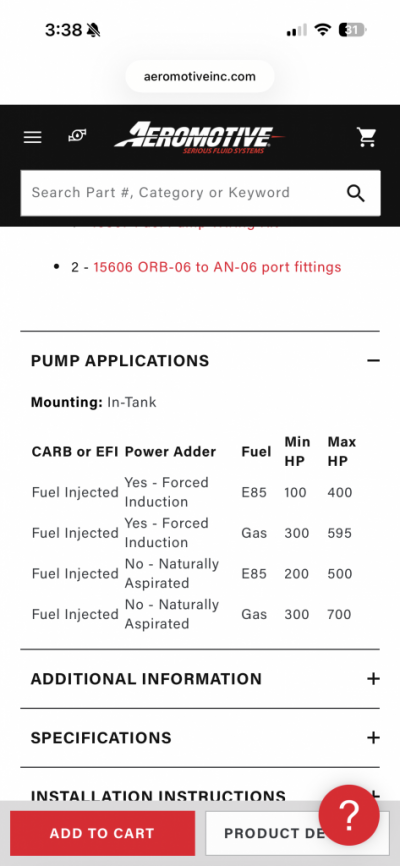
I’m shooting for 525whp n/a on e85, but I’d like at least a little room to grow. I probably could have gotten away with a 450lph but I think the 340 would have been way too small, even with a boost a pump. I know the calculators paint a much different picture, but in practical application I don’t know if I’ve ever seen a 340lph pump support much more than 600whp on gasoline, that would be 420whp on e (+30%). Aeromotive seems to echo that with their 340 stealth pump advertised hp rating listing it as capable of supporting 500hp on e85 (engine hp, so figure <450whp).
They are nice pumps though. I run two in my 96 impala with the second on a Hobbs switch and they are making over 700whp boosted without breaking a sweat.

I could be wrong. Lower base pressure enough with the right size injector , fuel lines sized accordingly and I’m sure you can get a lot out of a 340lph but I just don’t think I’ve ever seen anyone pushing over 500whp with one on e85. If there are, I’ll feel really stupid going with the 525 although a little overkill never hurt anyone. . It also means more fuel cycling back to the bucket. lol
 

Attachments

  • IMG_3248.png
    IMG_3248.png
    246.2 KB · Views: 2

GTS Dean

Enthusiast
Joined
Jul 22, 2000
Posts
4,153
Reaction score
480
Location
New Braunfels, Texas
The Racetronix 340 Jet is not E85 rated, but the 255 is. Try NOT to cut any window in the stock bucket, use a higher flow Jet in the stock position and add another demand-driven pump in the sealed bucket. Go with a modded reg outlet with external FPR and return.
 
OP
OP
K

Kris396ss

Enthusiast
Joined
May 25, 2025
Posts
45
Reaction score
32
Location
New York
The Racetronix 340 Jet is not E85 rated, but the 255 is. Try NOT to cut any window in the stock bucket, use a higher flow Jet in the stock position and add another demand-driven pump in the sealed bucket. Go with a modded reg outlet with external FPR and return.
I saw someone on YouTube do the window method while dropping a 255lph pump in (non jet) and I agree, I don't think it would be very effective at controlling fuel at all. Maybe good on a street car or drag racing with a full tank, but certainly not for a car that sees hard track use. In order to keep fuel from spilling out too quickly the windows or holes would have to be tiny, but that would also increase the time it takes to replenish the bucket. cut out larger windows and it'll flow out just as fast as it flowed in and be ineffective at keeping the pump submerged. It would basically be just like the RSI hanger with no bucket i.e; zero fuel control.

So you're saying there's room in the stock bucket for a second pump in addition to the primary jet pump?

If someone had the stock bucket and needed more flow than the 255 jet pump would provide, I still wonder if simply drilling the bucket and installing the aeromotive one way check valves would be an easier / effective solution allowing you to run any sized pump you could fit (assuming a 450 or 525lph pump fits the stock bucket, I wouldn't know since I don't have one). Take it for what it's worth but my testing with the one way check valves seemed promising and coupled with a bypass regulator feeding the bucket I think it would be effective at keeping the pump submerged when used with the stock bucket under almost any conditions. I'll update with on track results when I finally finish the car lol.

The radium Venturi is also an option as it can be plumbed into the return line for any pump used and provide a Venturi jet effect to fill the bucket. It's made for side saddle tanks but it could provide the same ability to fill the bucket using any pump of your choosing so long as you have a return line plumbed back into the bucket that you can tee off from.
 
Last edited:

GTS Dean

Enthusiast
Joined
Jul 22, 2000
Posts
4,153
Reaction score
480
Location
New Braunfels, Texas
There's room for a GSS style pump by trimming 1 or 2 spider legs and zip-tying it secure. Connect the 2 with Y fitting and go out with AN8 to a new pass through in place of the OE reg. The twin pumps will demand more wire gauge on all the feeds.
 

serafins

Enthusiast
Joined
Sep 2, 2024
Posts
130
Reaction score
71
Location
Metro Detroit
The Racetronix 340 Jet is not E85 rated, but the 255 is. Try NOT to cut any window in the stock bucket, use a higher flow Jet in the stock position and add another demand-driven pump in the sealed bucket. Go with a modded reg outlet with external FPR and return.
FYI for anyone looking at this in the future, Racetronix does make a 340lph jet that is E85 compatible. It is a special order. It is listed on the site but takes some digging to find and you have to call them to order anyways. Better off just calling.

Removing the ridiculously small diameter feed tube by ditching the OEM regulator should help volume a lot. Like Dean said go -8AN for your sizing. Doing this and dropping pressure to 2 bar will let the 340lph pump produce a true 340lph at 2 bar at stock voltage. No BAP required. There are several modern injectors that will flow more than enough for E85 at 2 bar and still retain good idle characteristics. Speaking with Racetronix and Deatschwerks (injectors) they both think this is the way to go for an E85 setup as opposed to running high pressure to increase flow through the factory small feed regulator.

I'm guinea pigging this and will post back if I need more pump. I like Dean's idea of a demand based pump if so.

The further I go down this path the more I get the feeling I should just spend the 4k and get a Motec standalone that would supply as much voltage as you could ask for to the pump and control bigger injectors better...
 

GTS Dean

Enthusiast
Joined
Jul 22, 2000
Posts
4,153
Reaction score
480
Location
New Braunfels, Texas
During Canada's insane COVID shutdown, my car was DEAD. I called and called and pleaded to get a pump back-channeled to me. Once they agreed, I doubled the order so I'd never have to go begging again.
 
OP
OP
K

Kris396ss

Enthusiast
Joined
May 25, 2025
Posts
45
Reaction score
32
Location
New York
FYI for anyone looking at this in the future, Racetronix does make a 340lph jet that is E85 compatible. It is a special order. It is listed on the site but takes some digging to find and you have to call them to order anyways. Better off just calling.

Removing the ridiculously small diameter feed tube by ditching the OEM regulator should help volume a lot. Like Dean said go -8AN for your sizing. Doing this and dropping pressure to 2 bar will let the 340lph pump produce a true 340lph at 2 bar at stock voltage. No BAP required. There are several modern injectors that will flow more than enough for E85 at 2 bar and still retain good idle characteristics. Speaking with Racetronix and Deatschwerks (injectors) they both think this is the way to go for an E85 setup as opposed to running high pressure to increase flow through the factory small feed regulator.

I'm guinea pigging this and will post back if I need more pump. I like Dean's idea of a demand based pump if so.

The further I go down this path the more I get the feeling I should just spend the 4k and get a Motec standalone that would supply as much voltage as you could ask for to the pump and control bigger injectors better...

340lph still isn’t that much for an e85 setup though. Again, I know the calculators claim that could support some crazy power but in practical application I don’t think I’ve ever seen one support much more than 475 or so or whp on E, granted an n/a application will do a bit better with a leaner AFR and generally lower fuel pressure.

I like Dean’s idea of using a jet pump and an additional pump but in some situations (like my current viper build) I prefer to have one pump just for reliability on a track car. I’d also be a little worried, if nobody has tried it, that the secondary pump along with the main pump would be able to drain the smaller size factory bucket pretty quickly (maybe too quickly) although that would probably have to be determined through some on track testing.

For my setup, I’m wiring the whole car from scratch anyway so supporting the amp demands of the 525lph pump isn’t a big deal. I also have an ECU that can support PWM for the pump, but I won’t be using that m since the design of my bucket/fuel control setup is being supplemented by return fuel flow lol I don’t think it’s needed with the one way valves and the capacity of the bucket, but it can’t hurt. It would be interesting to see if it worked adequately with a PWM/deadheaded system though. I don’t see why not.


Without having the stock bucket I don’t know if there would be any snags to installing them, but I still wonder if installing one way check valves along with any pump of your choosing would be the easiest and most effective solution. From the testing I did, it seems like it would be pretty damn effective at keeping fuel in the bucket. The bucket I’m using is huge, which is great for capacity but also allows fuel slosh in the bucket itself at very low levels. I don’t think I need the capacity of the bucket I’m using , even for the 525lph pump. The factory bucket may even work better, as lower fuel levels will still keep the pickup submerged when experiencing g forces with the bucket being smaller.


Again, my build has some very different needs from most viper guys but just some things to chew on that may be a good alternative/option/solution for more typical builds as well.
 
Last edited:

serafins

Enthusiast
Joined
Sep 2, 2024
Posts
130
Reaction score
71
Location
Metro Detroit
340lph still isn’t that much for an e85 setup though. Again, I know the calculators claim that could support some crazy power but in practical application I don’t think I’ve ever seen one support much more than 475 or so or whp on E, granted an n/a application will do a bit better with a leaner AFR and generally lower fuel pressure.

I like Dean’s idea of using a jet pump and an additional pump but in some situations (like my current viper build) I prefer to have one pump just for reliability on a track car. I’d also be a little worried, if nobody has tried it, that the secondary pump along with the main pump would be able to drain the smaller size factory bucket pretty quickly (maybe too quickly) although that would probably have to be determined through some on track testing.

For my setup, I’m wiring the whole car from scratch anyway so supporting the amp demands of the 525lph pump isn’t a big deal. I also have an ECU that can support PWM for the pump, but I won’t be using that m since the design of my bucket/fuel control setup is being supplemented by return fuel flow lol I don’t think it’s needed with the one way valves and the capacity of the bucket, but it can’t hurt. It would be interesting to see if it worked adequately with a PWM/deadheaded system though. I don’t see why not.


Without having the stock bucket I don’t know if there would be any snags to installing them, but I still wonder if installing one way check valves along with any pump of your choosing would be the easiest and most effective solution. From the testing I did, it seems like it would be pretty damn effective at keeping fuel in the bucket. The bucket I’m using is huge, which is great for capacity but also allows fuel slosh in the bucket itself at very low levels. I don’t think I need the capacity of the bucket I’m using , even for the 525lph pump. The factory bucket may even work better, as lower fuel levels will still keep the pickup submerged when experiencing g forces with the bucket being smaller.


Again, my build has some very different needs from most viper guys but just some things to chew on that may be a good alternative/option/solution for more typical builds as well.
Don’t take my comments the wrong way. I absolutely appreciate your thoughts. Viper community needs more innovation. Keep the posts coming.
 
OP
OP
K

Kris396ss

Enthusiast
Joined
May 25, 2025
Posts
45
Reaction score
32
Location
New York
Don’t take my comments the wrong way. I absolutely appreciate your thoughts. Viper community needs more innovation. Keep the posts coming.
Not at all! I appreciate your input (and GTS Dean's as well) and the discussion! It's nice being able to bounce some ideas around, and if my method doesn't work as well on track as I thought it would, at least I will have some backup plans to choose from now lol
 

serafins

Enthusiast
Joined
Sep 2, 2024
Posts
130
Reaction score
71
Location
Metro Detroit
FYI I've decided on using the 340lph racetronix pump plus a 17.5v boost a pump. This should turn the pump into about 520lph. Should give me some headroom on 93 pump gas to account for pumping losses. Probably gonna need about 400lph at the rails.
 
OP
OP
K

Kris396ss

Enthusiast
Joined
May 25, 2025
Posts
45
Reaction score
32
Location
New York
FYI I've decided on using the 340lph racetronix pump plus a 17.5v boost a pump. This should turn the pump into about 520lph. Should give me some headroom on 93 pump gas to account for pumping losses. Probably gonna need about 400lph at the rails.

If you haven't already, I would strongly suggest purchasing an rpm switch (or if boosted, a hobbs switch) to activate the boost-a-pump as I've never been a fan of just running the BAP full time. I've seen a few pumps burn out with short lifespans by doing that.

Will you be road racing the car at all? IF you area, please let us know how it works on track. My only concern with that setup is the fact that the volume of the stock bucket remains the same while the pump flow at WOT increased significantly. Assuming the Venturi/jet pump flows proportionately more, it wouldn't be an issue when the jet pump pickup is submerged but the jet pump pickup can become un-submerged very easily (if you check out the video I posted, you could see how fuel slosh in a tank the size/shape of a viper at lower levels could very easily move completely away from the center). As far as I know, the stock bucket only has one inlet for the jet pump, meaning slosh in any other direction may uncover the pickup and you're really relying on the fuel stored in the bucket BEFORE the high G event.
Then the question becomes, with no new fuel entering the bucket via the jet inlet on a hard turn or launch, will the bucket have enough volume to sustain 525lph (or a little over a half cup per second) for long enough to complete said turn/launch. I don't know the stock Viper bucket volume to do the math, but obviously you're not buying nearly as much time with a pump flowing 520lph to the Viper's 190LPH or gen 3 255LPH pump.

A return system of course could buy you more time in certain situations, especially ones where the G forces aren't happening concurrent with WOT (like a long/hard turn) to where ample fuel is being returned back into the bucket. Might not make much difference on a WOT launch unless your pump output way exceeds your fuel demand. For drag racing though I don't think any of this is really an issue as I've built quite a few sub 10 second cars with no fuel control/tank baffling at all and just always raced them over 3/4 of a tank. It's pretty easy to do drag racing, but much more difficult running 20 minute heats on a road course lol
 
Last edited:

GTS Dean

Enthusiast
Joined
Jul 22, 2000
Posts
4,153
Reaction score
480
Location
New Braunfels, Texas
Will you be road racing the car at all? IF you area, please let us know how it works on track.
Hot lapping and TT is what I do.
bucket volume to do the math, but obviously you're not buying nearly as much time with a pump flowing 520lph to the Viper's 190LPH or gen 3 255LPH pump.

A return system of course could buy you more time in certain situations, especially ones where the G forces aren't happening concurrent with WOT (like a long/hard turn) to where ample fuel is being return...
Road America and COTA have been no problem at all, but I'm only making around 470 wheel with stock tune and injectors.
and just always raced them over 3/4 of a tank. It's pretty easy to do drag racing, but much more difficult running 20 minute heats on a road course lol
I have run my car down to as little as 2 to 3 gallons remaining at COTA several times with NO fuel starvation issues AT ALL.
 
OP
OP
K

Kris396ss

Enthusiast
Joined
May 25, 2025
Posts
45
Reaction score
32
Location
New York
Hot lapping and TT is what I do.

Road America and COTA have been no problem at all, but I'm only making around 470 wheel with stock tune and injectors.

I have run my car down to as little as 2 to 3 gallons remaining at COTA several times with NO fuel starvation issues AT ALL.

That’s awesome! That definitely sounds like the way to go for hp levels up to what the 340lph pump could support on either pump or e. I’m assuming that’s without a boost-a-pump correct if you’re making 470 on regular gas? I figured the bucket would have enough capacity for at least a 255, since the gen 3 used a 255 pump with the same size bucket as far as I know. From your experience, it sounds like it definitely can support the demands of a 340 as well. Stretching that to 520lph with a boost a pump though is going to be draining that bucket quite a bit faster

I don’t think it would be an issue on a road course with a return system since most likely the most extreme/sustained g forces you’d be seeing would be in turns or on stopping in which case most of the fuel would be getting returned anyway back to the bucket.

May be more of an issue on a drag track in a fast car where you could be seeing sustained g’s with 9+ seconds of WOT potentially drinking most of that fuel down.
 

serafins

Enthusiast
Joined
Sep 2, 2024
Posts
130
Reaction score
71
Location
Metro Detroit
If you haven't already, I would strongly suggest purchasing an rpm switch (or if boosted, a hobbs switch) to activate the boost-a-pump as I've never been a fan of just running the BAP full time. I've seen a few pumps burn out with short lifespans by doing that.

Will you be road racing the car at all? IF you area, please let us know how it works on track. My only concern with that setup is the fact that the volume of the stock bucket remains the same while the pump flow at WOT increased significantly. Assuming the Venturi/jet pump flows proportionately more, it wouldn't be an issue when the jet pump pickup is submerged but the jet pump pickup can become un-submerged very easily (if you check out the video I posted, you could see how fuel slosh in a tank the size/shape of a viper at lower levels could very easily move completely away from the center). As far as I know, the stock bucket only has one inlet for the jet pump, meaning slosh in any other direction may uncover the pickup and you're really relying on the fuel stored in the bucket BEFORE the high G event.
Then the question becomes, with no new fuel entering the bucket via the jet inlet on a hard turn or launch, will the bucket have enough volume to sustain 525lph (or a little over a half cup per second) for long enough to complete said turn/launch. I don't know the stock Viper bucket volume to do the math, but obviously you're not buying nearly as much time with a pump flowing 520lph to the Viper's 190LPH or gen 3 255LPH pump.

A return system of course could buy you more time in certain situations, especially ones where the G forces aren't happening concurrent with WOT (like a long/hard turn) to where ample fuel is being returned back into the bucket. Might not make much difference on a WOT launch unless your pump output way exceeds your fuel demand. For drag racing though I don't think any of this is really an issue as I've built quite a few sub 10 second cars with no fuel control/tank baffling at all and just always raced them over 3/4 of a tank. It's pretty easy to do drag racing, but much more difficult running 20 minute heats on a road course lol
My car with the 190lph stock Gen 2 pump and injectors made 465rwhp on Prefix's dyno. No fuel related issues whatsoever on track even during 30 minute sessions with low fuel.

Regarding the BAP, it will be triggered by the throttle position sensor. It will start ramping from the factory 13.5V at about 40% throttle, then max out at 17.5v by 80% throttle.
The racetronix pump is rated for 18v max so it should be totally fine. I'm upgrading the wiring from the BAP to the new fuel pump too obviously.

Regarding the bucket, I hadn't considered that but I don't think it will be an issue. The pickup is directly on the bottom of the bucket. The tank actually has a divot that the bucket sits in that holds even more fuel for the bucket to pick up. You'd have to pull serious lateral G's at full throttle to uncover the bucket inlet for long enough to drain the bucket.
Plus, the factory bucket is actually quite large compared to other cars I've had, like a newer mustang running a BAP on E85 to 500whp on the stock 300ish lph pump. That car had no fuel issues on track even with a crappy, small bucket and no Venturi fill system.

IF I start running out of fuel, I will go with the idea of the one-way check valves in the bottom of the bucket. That would completely eliminate the bucket volume issue I think. Or run a second Venturi split off the pressure line with a draw line on the other side of the tank.

Additionally, these cars are essentially a return fuel system. The regulator dumps fuel back into the bucket rather than the tank. I'm keeping that setup with an aftermarket adapter to run an external regulator.
 
Last edited:

serafins

Enthusiast
Joined
Sep 2, 2024
Posts
130
Reaction score
71
Location
Metro Detroit
The BAP module I used is the P2000GM by JMS. I used the GM version for two reasons. First It allows voltage ramping based on a 5 volt sensor. The viper TPS is a 5 volt sensor so I can run it off the TPS instead of RPM which would have been complex and laggy based on how these cars send the RPM signal. The second reason is the GM version starts the voltage ramp at the input voltage, which is 13.5V on these cars, instead of 14.5 volts like all other models. That means I can set it to kick on sooner and ramp more gently since I get another 25% of output range to adjust.
 
Top