Power Steering Cap Fix

maverickagm

Enthusiast
Joined
Jun 9, 2023
Posts
109
Reaction score
64
Location
New Westminster
This solution might be a bit overkill, but here's how I addressed the infamous power steering cap issue.

I routed a 3/8" hose from my cap breather to an oil catch can.

1) It prevents fluid from spraying up and onto the exhaust manifold

2) In the event of the cap coming loose, the hose will prevent the cap from coming off.

I bought this very basic 300ml catch can:
The exact same thing is sold under many different brand names....

I welded a simple bracket and used two of the existing heat shield bolts.

There's enough clearance to unscrew the catch can to empty it. There's also a handy dip stick on top that does clear the brake booster.

I think this solution is reasonable. Maybe there's some downside or error that I'm not seeing. If so, feel free to comment below.

You must be registered for see images attach

You must be registered for see images attach

You must be registered for see images attach

You must be registered for see images attach

You must be registered for see images attach
 
Last edited:

JRSViperRT

Enthusiast
Joined
Jan 27, 2024
Posts
66
Reaction score
5
Location
Senoia, GA
This solution might be a bit overkill, but here's how I addressed the infamous power steering cap issue.

I routed a 3/8" hose from my cap breather to an oil catch can.

1) It prevents fluid from spraying up and onto the exhaust manifold

2) In the event of the cap coming loose, the hose will prevent the cap from coming off.

I bought this very basic 300ml catch can:
The exact same thing is sold under many different brand names....

I welded a simple bracket and used two of the existing heat shield bolts.

There's enough clearance to unscrew the catch can to empty it. There's also a handy dip stick on top that does clear the brake booster.

I think this solution is reasonable. Maybe there's some downside or error that I'm not seeing. If so, feel free to comment below.

You must be registered for see images attach

You must be registered for see images attach

You must be registered for see images attach

You must be registered for see images attach

You must be registered for see images attach
Where does the second hose go from the catch can?
 
OP
OP
M

maverickagm

Enthusiast
Joined
Jun 9, 2023
Posts
109
Reaction score
64
Location
New Westminster
Just down towards the ground. Only air should come out of it. If I was really negligent, power steering fluid would overflow out the outlet port and spill out the outlet port. Without the second hose, it could overflow onto the heat shield and potentially drip onto the exhaust. The hose just moves it away from the left side exhaust system.
 
Last edited:

LifeIsGood

Enthusiast
Joined
Jun 1, 2008
Posts
2,283
Reaction score
12
Location
Viper Lane, Arizona
From Viper Buyer's Guide (by Maurice Q. Liang)...

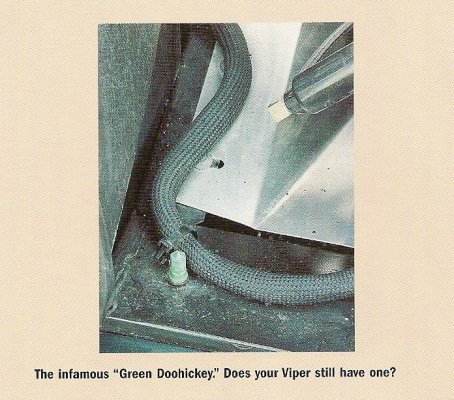
"Perhaps the most interesting hard-to-find part is not even an official part. It's the infamous 'Green Doohickey' found under the hood. As the frame was being painted, workers simply installed a small green protective screw cap on the grounding post, used for battery charging and jump starting. This cap stopped the protective electrostatic paint from coating this post. Assembly craftsmen at the Viper plant simply left this piece on the post for 6 years of Viper production. It had no part number, no internal cost factor-but every 1992 to 1996 Viper RT/10 had one! However, many dealers and owners discarded the Doohickey when they discovered it had no function. But with no part number, it's impossible to replace."
 

Attachments

  • Green Doohickey photo.jpg
    Green Doohickey photo.jpg
    192.8 KB · Views: 39
OP
OP
M

maverickagm

Enthusiast
Joined
Jun 9, 2023
Posts
109
Reaction score
64
Location
New Westminster
So I was at Monster Jam today and one of the truck's headers caught fire. It was safely extinguished and taken to maintenance. They announced the cause was power steering fluid spraying onto the headers..... I would have thought the fluid would smoulder more than completely ignite.
 
Last edited:

doctormosfet

Enthusiast
Joined
Jul 27, 2025
Posts
51
Reaction score
36
Location
Mahopac, NY
I was inspired by this thread to do the same (or as close as I could get) although, in my case, the windshield washer fluid reservoir is also in that area and makes a good fit a bit more challenging. I used the exact same catch can but, since I don't/can't weld, I did not assemble a T-bracket. Instead, I picked up an L-bracket from Lowe's, which is beefy enough for the job. Some measuring, drilling, cutting, then some more drilling and cutting through iteration to get the right fit, and I ended up with this.

I mounted the catch can at an angle to give a bit more clearance against the brake master cylinder. This is because I have to push the catch can further inward owing to the windshield washer fluid reservoir taking up too much space close to the fender, which means it mostly sits under the brake master cylinder. There is just barely enough room to unscrew the catch can, although removing it entirely is challenging and would likely end up spilling fluid if it were full. This is because I'd have to rotate it back a bit after unscrewing it just to get it out of there. I guess it's better to mop up some goop than have a fire, though, right?

I mounted this initially with the can unscrewed, as I need enough clearance to wrench on those two mounting screws. Then, I screwed the catch can on (not so easy, given the angle and space you have to work with) and then screwed the dip stick into the cap. Space constraints also more or less require me to route the fuel line around the side of the windshield washer fluid reservoir and over to the power steering fluid cap. This should be better than coming in from under the master cylinder and wrapping the fuel line around to the input, since in this case there is no risk of the line pinching by having to make any sharp bends.

I also made sure to leave enough slack in there to be able to move the line around a little bit if I need to (e.g., for clearance with the hood). From the top, you can just barely see the dip stick. Unless you have midget hands, you're not getting it out of there without first removing (or at least unscrewing and pushing aside) the windshield washer fluid reservoir. I have to push from the back of the L-bracket (reaching around the master cylinder) to make it flex forward just a bit so I can actually get the dip stick out all the way (or to get it in there), as otherwise the master cylinder blocks it just a bit. Again, it's a tight fit. Maybe someone else could do better by a few mm here or there, but for a h*nd j*b (ahem), I'm rather pleased overall. I routed the output line over the exhaust heat shield and wrapped it in some aluminum tape. I figure this is the least bad place in the event of serious overflow, as it would just drip down the heat shield under the chassis. It would be really cool if this catch can were clear so that you could actually see any fluid in there without having to contort yourself just to get the dip stick out. I mean...you could literally just do that with one of those Chinese food take-out soup cups bolted to the side, but what's the fun in that.
 

Attachments

  • 01.jpg
    01.jpg
    157.9 KB · Views: 8
  • 03.jpg
    03.jpg
    101.4 KB · Views: 7
  • 06.jpg
    06.jpg
    140.2 KB · Views: 6
  • 07.jpg
    07.jpg
    110.9 KB · Views: 7
  • 09.jpg
    09.jpg
    107.5 KB · Views: 8

doctormosfet

Enthusiast
Joined
Jul 27, 2025
Posts
51
Reaction score
36
Location
Mahopac, NY
More pics.
 

Attachments

  • 11.jpg
    11.jpg
    143.3 KB · Views: 8
  • 12.jpg
    12.jpg
    123.3 KB · Views: 8
  • 13.jpg
    13.jpg
    119.3 KB · Views: 11
  • 15.jpg
    15.jpg
    170.8 KB · Views: 11
  • 16.jpg
    16.jpg
    153.7 KB · Views: 11

serafins

Enthusiast
Joined
Sep 2, 2024
Posts
106
Reaction score
56
Location
Metro Detroit
I think you'd want it to function more like a coolant overflow reservoir - such that when the fluid gets hot and expands, it dumps into the reservoir, but then when the fluid cools back down, it contracts and creates a vacuum which ***** the fluid in the reservoir back into the pump to keep it topped off. This can be accomplished by using a coolant overflow bottle which has a single fitting on the bottom and a vent on the top. That is what I am doing.
 

Ivory

Enthusiast
Joined
Oct 27, 2000
Posts
167
Reaction score
1
Location
Madison, WI
Does this impact a Gen 1 viper? Are there any less invasive solutions? I have a gen 1 with the original power steering pump and cap. 26 years of ownership and 73,000 miles on it and never had an issue. Thoughts, recommendations, suggestions?
 

doctormosfet

Enthusiast
Joined
Jul 27, 2025
Posts
51
Reaction score
36
Location
Mahopac, NY
Does this impact a Gen 1 viper? Are there any less invasive solutions? I have a gen 1 with the original power steering pump and cap. 26 years of ownership and 73,000 miles on it and never had an issue. Thoughts, recommendations, suggestions?
I haven't had an issue with mine yet either, although I've only had the car since last summer. Never had the cap even get loose on me. I can only guess that this is more of an issue with track use, but I'd rather have that little bit of extra protection if that 1% chance shows up. If it's a known issue for Gen 2, then it is very likely also an issue for Gen 1.

I'm interested in serafins' overflow reservoir approach, although I'd like to see some pictures to see how exactly that was done.
 
OP
OP
M

maverickagm

Enthusiast
Joined
Jun 9, 2023
Posts
109
Reaction score
64
Location
New Westminster
Ya'll might be overthinking this a bit. The minimum viable solution is the 3rd picture here:

Just attach a hose so that if you are going to spray fluid out the air vent, it goes down instead of up. This shouldn't happen under normal circumstances but mistakes happen. Air can get into the system or it could be over-filled when serviced. So that, combined with turn at high engine rpm could cause a spray.

You do not want an overflow reservoir that feeds the fluid back into the pump. If any fluid is in the overflow reservoir, it's because the power steering reservoir was overflowing.

The catch cans aren't necessary. I was just curious if I would ever find anything in there and I never have (not with my granny-driving anyways). If you're also curious, then go for it.
 

doctormosfet

Enthusiast
Joined
Jul 27, 2025
Posts
51
Reaction score
36
Location
Mahopac, NY
Yes, I've heard of the ROE Racing pipe. I'd prefer a catch can so I'm minimizing any spillage of fluid out of the car and onto the road, or maybe even onto some other part of the car and end up making a mess. It is overkill for sure, but should be cleaner.
 

serafins

Enthusiast
Joined
Sep 2, 2024
Posts
106
Reaction score
56
Location
Metro Detroit
Hose going down still makes an F'n mess. Ask me how I know. I have pretty extensive experience with pump issues on my 68 mustang that has one of the worst power steering designs ever. I burned up three pumps before going to an overflow setup. I find PS fluid expands and contracts quite a bit with heat and the ford pumps are very sensitive to fluid level. Not sure if the viper is the same but I don't see how an overflow system can hurt at all. You're essentially just adding a bigger reservoir.
 

GTS Dean

Enthusiast
Joined
Jul 22, 2000
Posts
4,118
Reaction score
455
Location
New Braunfels, Texas
Stock coolers are not fully up to the task of track duty on hot days. Some folks go ahead with a larger steering cooler. IMO, the biggest issue is lack of engine compartment ventilation behind the radiator. Anyhoo, I run a long 3/8" hose from the cap nip ple down near the rear LCA mount and zip tie it to the inboard brake line terminus. It will drip just a little bit over the weekend, but nothing excessive at all.
 
Top